Seminar recap · 24 Nov 2026
Does the EU "AI‑generated" marking duty apply to our service?
We held a seminar on the machine-readable marking duty under Article 50(2) of the EU AI Act. Here is what we covered, with the slides, practical templates, the Q&A summary and a short explainer video. The materials are in Korean.
- Event
- 3rd Regulatory Information Exchange on AI and Cybersecurity
- Date
- Tue 24 Nov 2026, 13:00–14:00 (KST)
- Venue
- Online · main hall, My Workspace Gangnam Station, Seoul
- Hosted by
- Korean Agency for Technology and Standards (KATS) · TBT AI & Cybersecurity Committee
- Speaker
- Song-Yi Yang, Chair, TBT AI & Cybersecurity Committee
Article 50(2) in two minutes
The seminar's key points as a captioned video without narration. On-screen text is in Korean.
What we covered
Slides are in Korean.

AI marking is a "country of origin" label for content
Just as goods carry "Made in", AI-generated text, images, audio and video carry the fact that AI made them. A mark does not vouch for the content; it only tells you AI made or changed it.
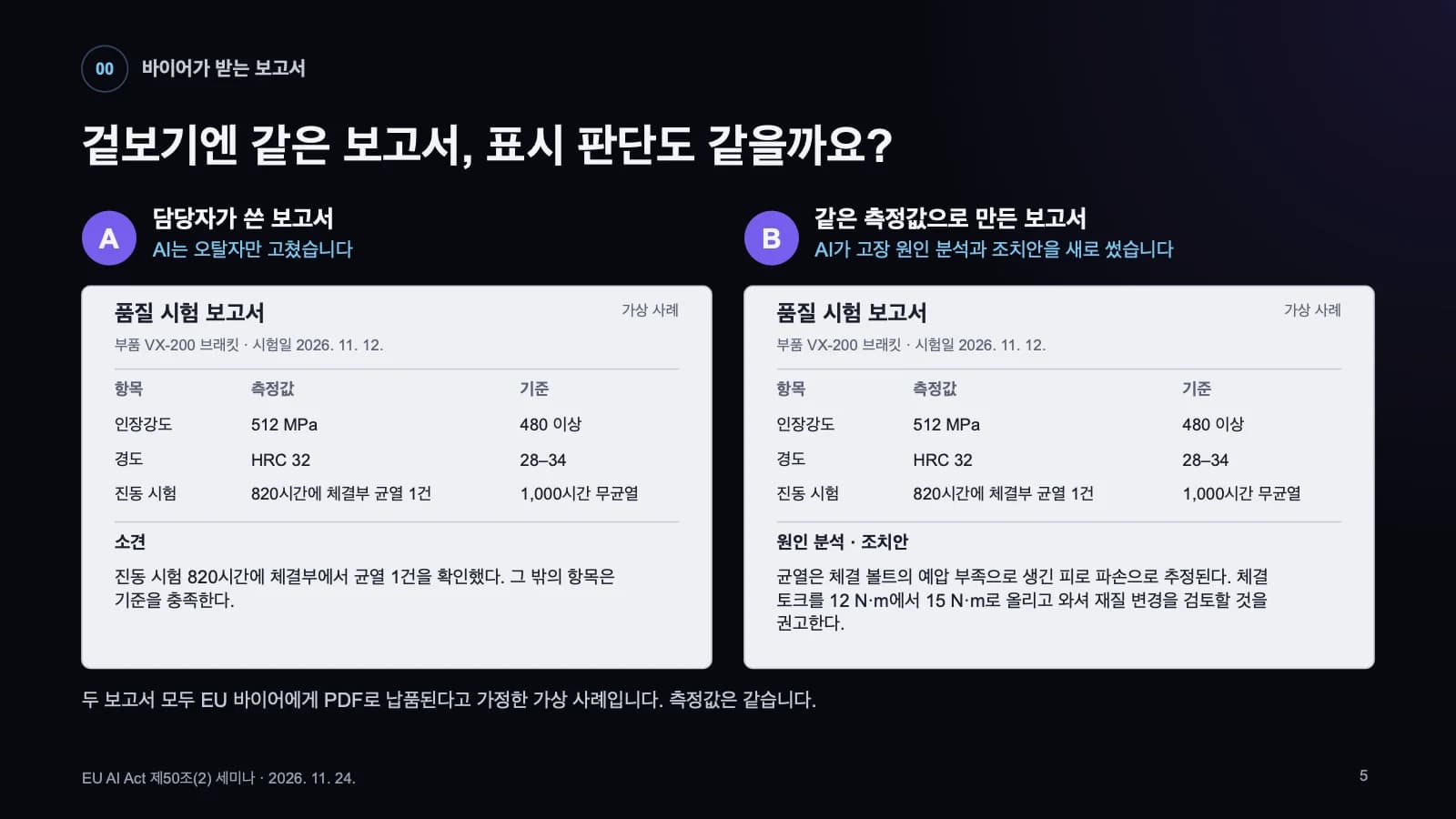
Two reports that look the same — is the answer the same?
Two fictional quality test reports with identical measurements. In A, a staff member wrote it and AI only fixed typos; in B, AI newly wrote the failure analysis and corrective actions from the same data. Both go to an EU buyer as PDFs.
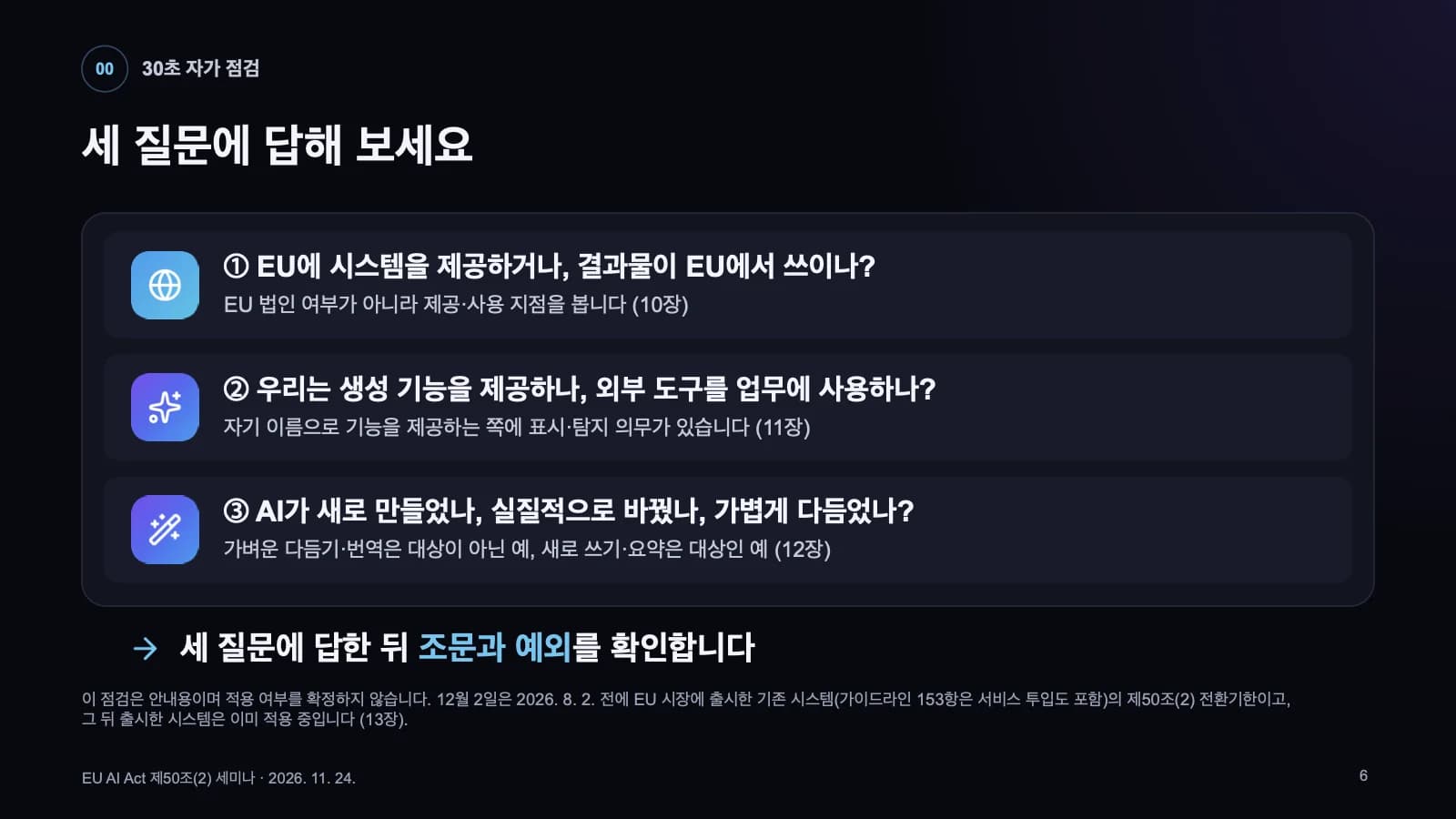
Three questions to check
① Is the output used in the EU? ② Do you provide the generating function, or only use a tool? ③ Did AI create something new, or only lightly edit? Reports A and B part ways at the third question — like origin rules: repackaging keeps the origin, substantial transformation changes it.
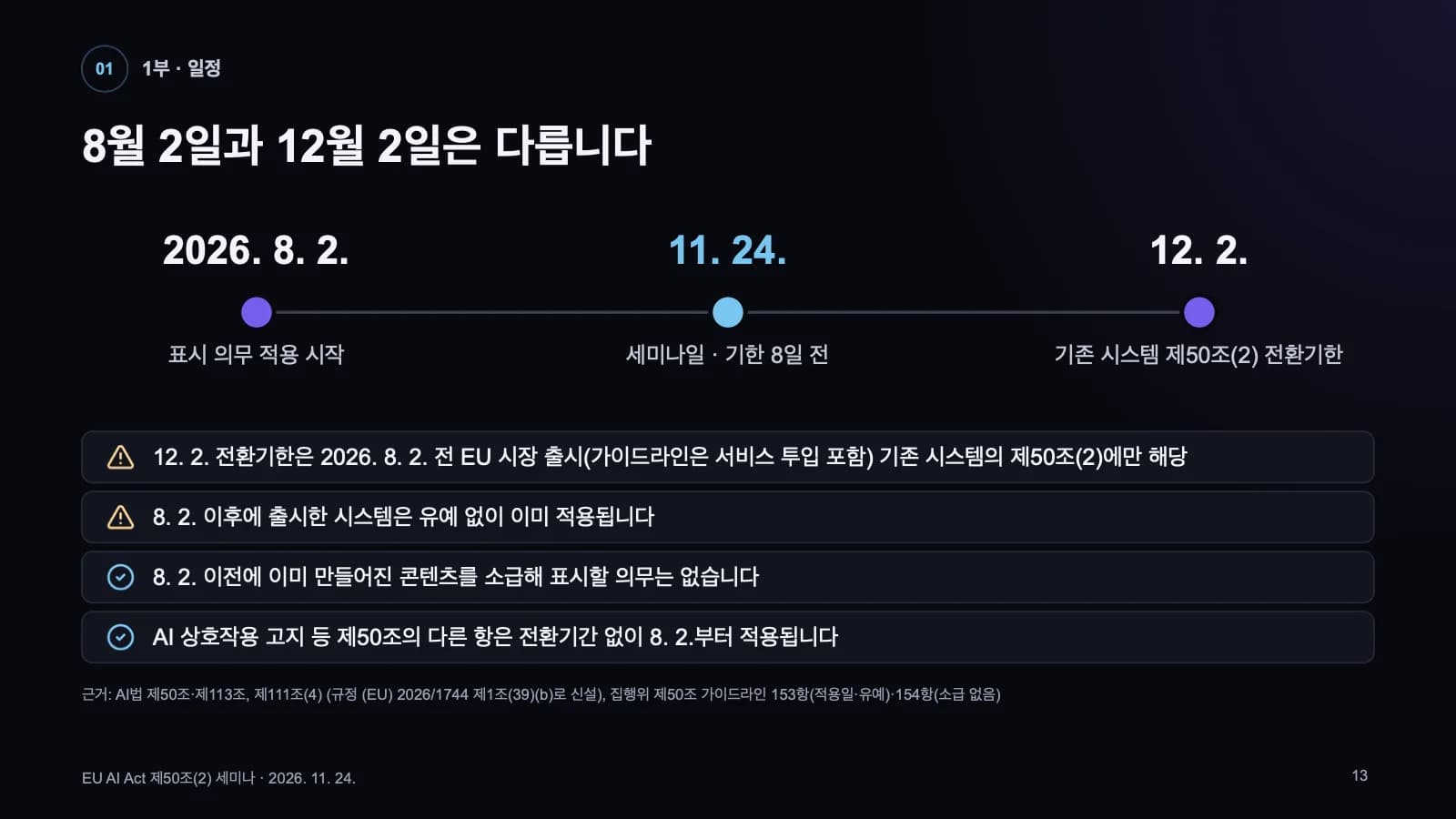
2 August and 2 December are different dates
The marking duty has applied since 2 August 2026. 2 December 2026 is the Article 50(2) transition date only for systems placed on the EU market before 2 August; systems launched after that are already covered. The Article 50(1) notice that people are talking to an AI has no transition period.
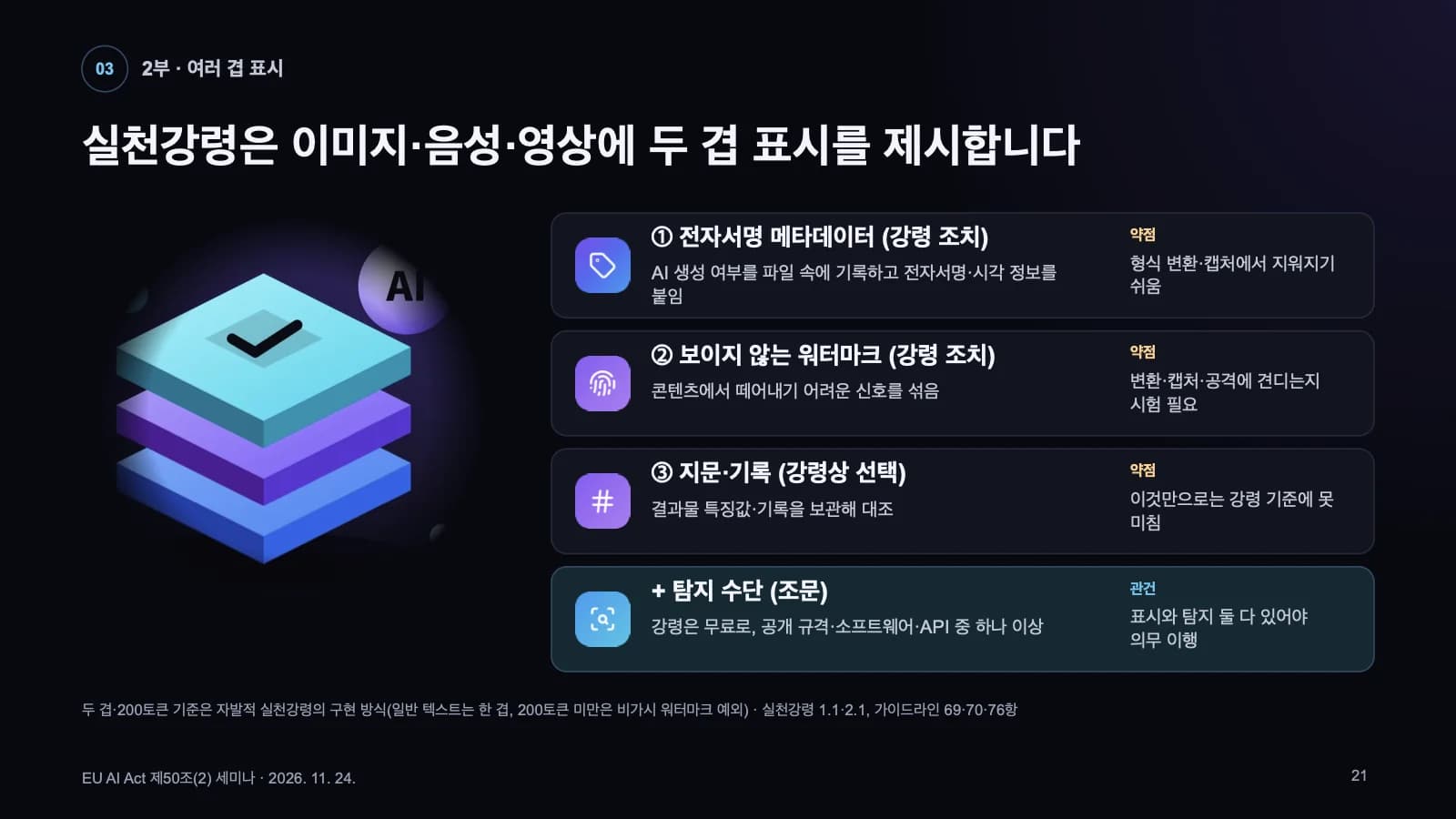
The code of practice sets out two layers
The Article requires machine-readable marking and detectability. The voluntary code of practice sets out two layers — signed metadata plus an imperceptible watermark — for images, audio, video and text inside files, and one watermark layer for plain text.

A six-item checklist for 2 December
Start by confirming when you launched in the EU — whether a transition period applies sets the rest of the schedule. The checklist sits at the top of sheet ⑨ in the templates.
Questions from the floor
What if an overseas sales team sends an EU buyer a document made with an in-house generative AI?
It first turns on who built that in-house AI. If the company simply uses an external AI tool as is, the Article 50(2) duty sits with the company that provides the tool. If the company built the system itself, or built its own system on top of an external model under its own name, it may be treated as the provider — and because the output leaves the company, the internal-use exception does not apply. The fix is not for staff to add a line to the email; the team running the in-house AI should put machine-readable marks in the files and check they survive in the final deliverable.
Basis: AI Act Art. 2(1)(c), 3(3), 50(2) · Guidelines points 15 and 87
What about functions that talk to drivers, like an in-car AI assistant?
Two duties apply separately. Because it talks to drivers, it needs the Article 50(1) notice that they are interacting with an AI; because it produces synthetic speech, it also needs Article 50(2) machine-readable marking. One cannot stand in for the other, and Article 50(1) has applied since 2 August 2026 without a transition period.
Basis: AI Act Art. 50(1), (2), (5) · Guidelines point 153
Do AI safety functions such as worker detection or automated driving count?
Article 50(2) is about marking content that AI generates. Safety functions that judge or control machines are handled through conformity assessment before they reach the market, not through marking — check the Machinery Regulation (EU) 2023/1230 for machinery and the type-approval rules for vehicles. But if the equipment produces AI-written inspection reports or voice guidance for people, those outputs are assessed under Article 50.
Basis: AI Act Art. 2(2), 6(1), 50(2), (6) · Machinery Regulation (EU) 2023/1230
All 33 questions and answers are in the Q&A summary PDF below (Korean).
Get the seminar materials
Leave your email to download right away. All materials are seminar guidance as of 24 November 2026, in Korean, and are not legal advice.
Materials
- Seminar slidesPDF · 37 slides · 2.0MBThe talk deck without the company case study, plus a three-slide Q&A appendix.
- Ten practical templates (revised)XLSX · 32KBThe top six rows of sheet ⑨ are the 2 December checklist.
- Article explainer & Q&A summaryPDF · 10 pages · 0.9MBRequirements, exceptions and timeline, plus 33 Q&As
- Explainer videoMP4 · 2 min 16 s · 4.9MBThe two-minute video above
Questions about the materials
ceo@connectai.bizThese materials are seminar guidance, not legal advice. Whether the rules apply depends on the text of the law and each company's facts.
Seminar announcement (Korean)