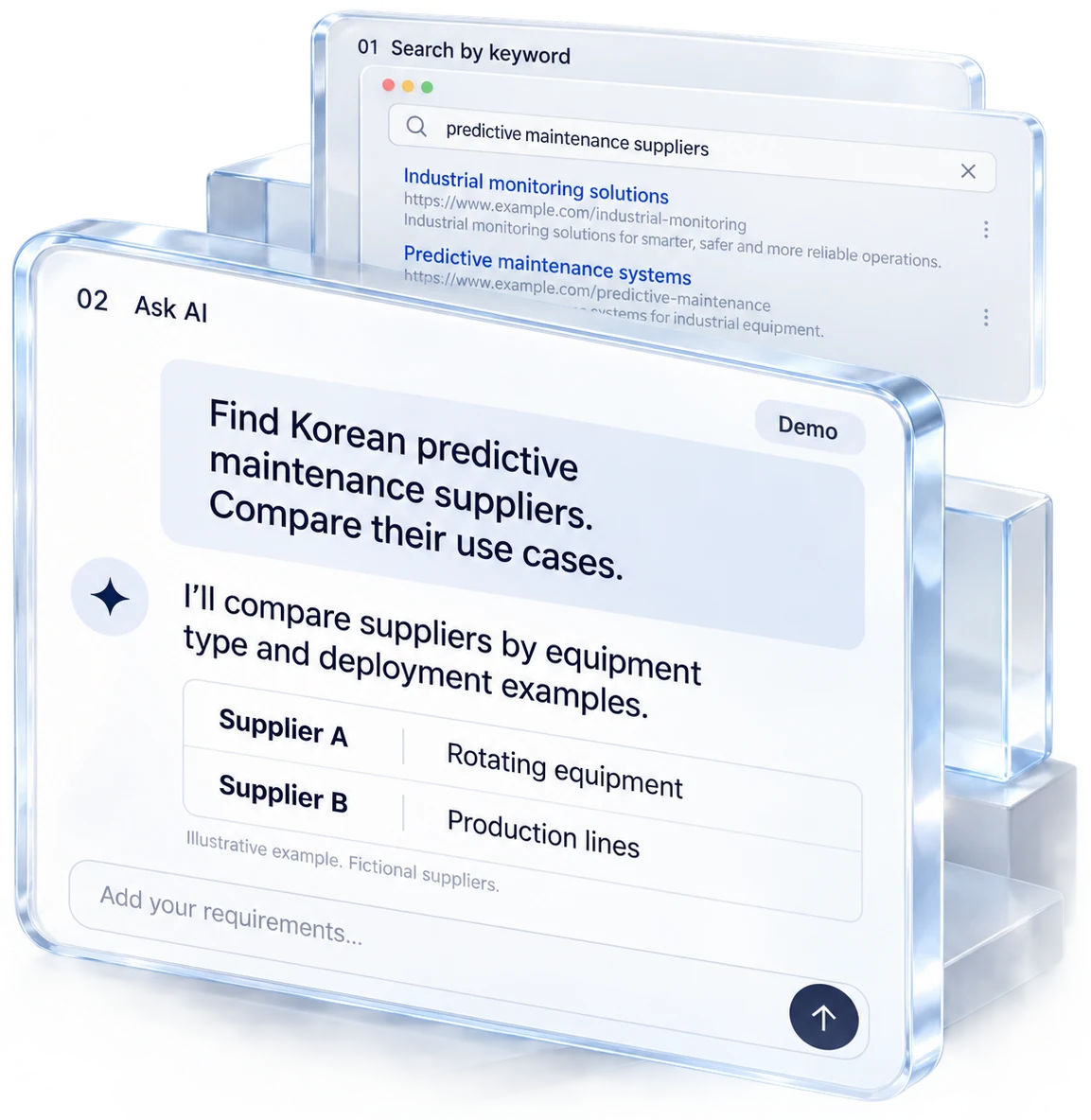
Buyers used to type a product name into a search box and open the results one by one. Now they ask an AI once and look at the few companies it puts forward. What changed is not the tool but the order.
The way buyers search has changed
Before, appearing in a list was enough — a person came and read your site. Now a machine reads first, and the companies it can answer with are the ones that reach a person. A company with the same technology that does not appear at that step is not rejected by the buyer — it is simply never seen, and the buyer moves on.
There is a common misunderstanding: that responding to AI search is a matter of advertising or ranking. It is simpler than that. When a buyer asks “find Korean suppliers of water-treatment membranes for industrial wastewater reuse,” an AI reads the public information of companies that could be candidates. The company name, what the company actually does, credible evidence, a description in English the buyer can read, and how to get in touch — roughly five things get read.
Many companies have the first and little else. The name is everywhere, but what the company does is not written in a single sentence; the case histories and certificates sit inside a PDF; the English description covers one product out of twelve; and the contact path is a single generic address.
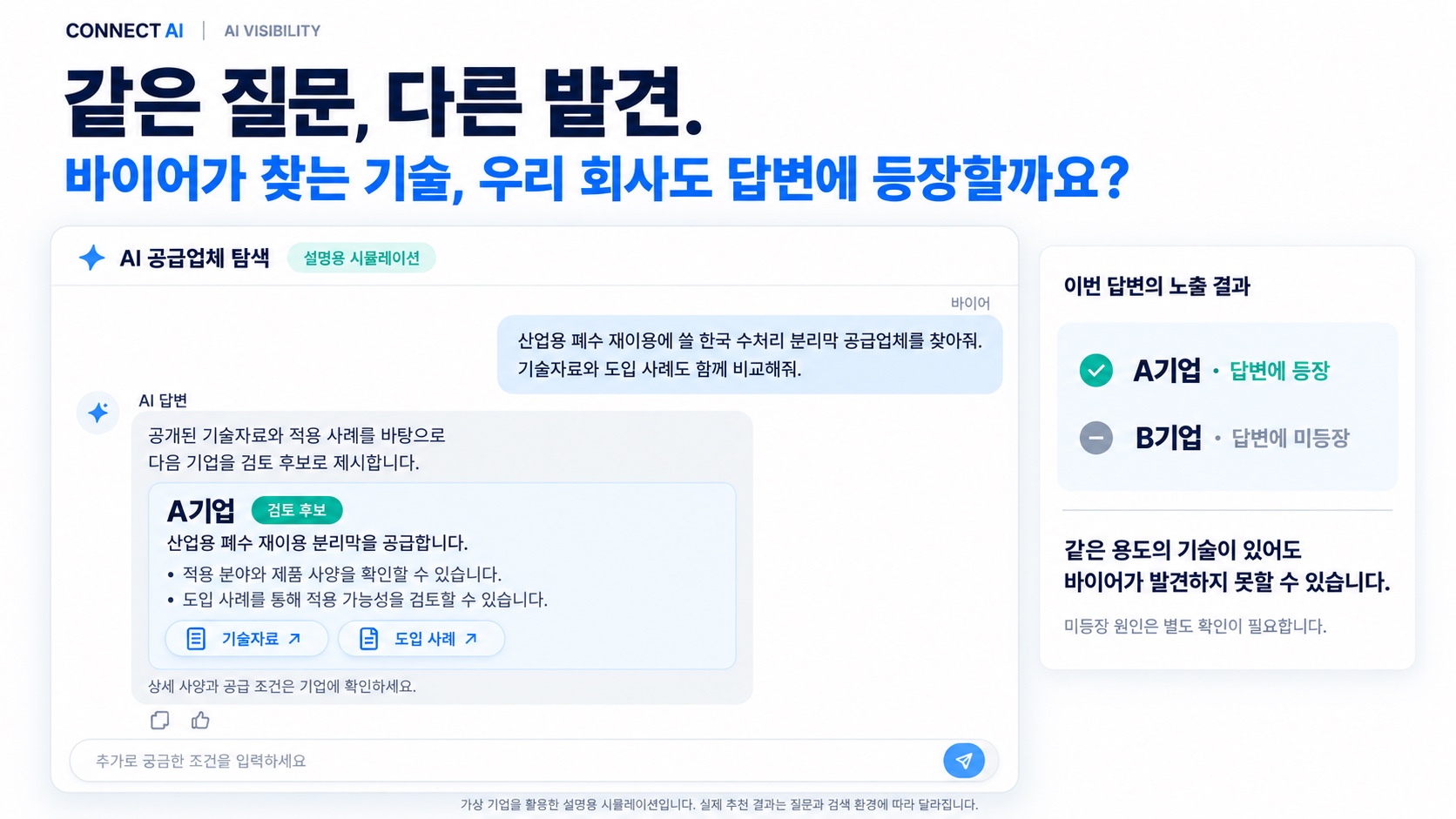
Same question, different outcome
An illustrative construction using fictional companies. Not an actual search result.
| Compared | Company A · among the candidates | Company B · not among them |
|---|---|---|
| Technology held | Can supply water-treatment membranes for this use | Can supply water-treatment membranes for this use |
| Public technical information | Application field, specifications and case histories are verifiable | A company profile exists, but application field, specifications and cases are thin |
| What the sample answer shows | Company name + why it fits + source for the technical data | The company name does not appear |
| The buyer’s next move | Review the technical data, then open a supply conversation | This answer gives them no way to evaluate the company |
Both companies hold the same technology. What separated them was not the technology but whether the material to answer the buyer’s question was public.
One more thing. A real answer does not tell you that a missing company “cannot be recommended.” It simply shows the other companies and stops. So we do not fill Company B’s column with an invented refusal — we write what was observed: “not included among the candidates in this answer.”
An AI cannot cite what is not written. So given the same question, some companies are included among the candidates and some can be left out.
This is what we call AI visibility: the state in which an AI can read your company and answer with it when a buyer asks. It is not about lifting a search ranking — it is about whether you are material the answer can be built from.
Source · co-authored book Trading on a Hyperconnected Planet
Three gates
Between a buyer’s question and your sales contact there are three gates. If one is broken, everything upstream of it never arrives.
Is it settled which questions your company should connect to? Do your company and technology descriptions sit where machines can read them?
Are use cases and differentiators written in the order a buyer evaluates them? Does each claim sit next to something checkable?
Once a buyer has finished evaluating, is there somewhere to ask? Does that inquiry actually reach a person?
Results are observations under the conditions we checked. We do not guarantee any particular AI’s recommendation or search placement, and we do not collect answers by sending questions to an AI.
We check repeatedly in fresh conversations under the same question, service, language and search settings, and record whether the company name appeared, the stated reason, and the source links.
What the twelve weeks contain
AI Search Readiness for Overseas Buyers (AI Visibility Export 12) runs for twelve weeks of build, review and handover, based on one company and two core products.
The twelve weeks bring a customer to three kinds of readiness. Ready to be found — decide which buyer and which question you connect to, and organize company and technology descriptions and public evidence. Ready to be evaluated and contacted — put use case, differentiators, certification evidence and FAQ into the company profile, brochures and website, and connect the inquiry path. Ready to continue the conversation — learn to manage interest, questions, sent material and next contact in MORI, and take operations over.
| Weeks | Main work | What the customer confirms |
|---|---|---|
| 1–4 | Target market, buyer questions, baseline check. Public evidence, web and brochure structure, copy preparation | Provide product and evidence material; confirm the direction of the copy |
| 5–7 | Company brochure production and revision; base version of the website. Review of the inquiry path | Review the company profile and the base website |
| 8–9 | Product A and Product B in sequence. Web, FAQ and public evidence filled in | Approve per-product descriptions and answers |
| 10–11 | Final review. Approved answers and chatbot applied; MORI connected and inquiry handling practised | Approve materials; operator practice |
| 12 | Re-measurement of the published version and a before/after report. Final handover and the 90-day plan | Confirm handover and settle the follow-up operating plan |
| Item | Quantity and scope | Owned or licensed |
|---|---|---|
| Website | One set. One language as standard; further languages by agreement | Company-owned |
| Interactive e-brochures | 1 company profile + 2 core products = 3 total | Company-owned |
| FAQ and certification evidence | 50 items, built from approved facts and sources | Company-owned |
| AI chatbot | Loaded with the same 50 approved answers | System use |
| Diagnostic report | Twice — before and after the build, on agreed questions and conditions | Company-owned |
| MORI follow-up sales | Lead, customer history and follow-up management, one year | System use |
| Follow-up plan | One 90-day execution plan | Company-owned |
The website, brochures, FAQ, diagnostic reports and 90-day plan are owned by the company. At the end of the twelve weeks your own operator takes them over.
An AI cannot cite what is not written. What separates companies is not the technology but whether the material to answer the buyer’s question was public.— AI visibility
The build date and the AI-search date are not the same
Google states that re-crawling changes can take anywhere from a few days to a few months. So we record the completion date and the AI-search reflection date separately, along with the observation date and the period the content was public.
Google also recommends crawlability, trustworthy content and putting key information in text — but states that meeting those requirements does not guarantee appearance. So we do not judge a company’s technology or readiness from a single answer it did not appear in. We do not tune the question until a particular company shows up; the question is set from the buyer’s real purchasing conditions first.
CES 2027 runs 6–9 January 2027. We do not promise to compress the whole twelve-week specification just because an event date is close. Instead we start by reviewing the existing website and already-approved material, and publish approved assets in sequence.
What is AI visibility?
It is the state of being readable and citable by an AI when a buyer asks. It is not about lifting a search ranking — it is about whether the material an answer can be built from is public. The term comes from the co-authored book Trading on a Hyperconnected Planet.
How is this different from building a website?
We start by deciding which buyer questions you need to answer. We build the product explanations, the evidence and the inquiry path those questions require, then connect MORI for managing the inquiries that follow and hand operations over. The point is that what gets built is actually used in evaluation and follow-up sales.
If an AI recommendation is not guaranteed, why do this?
We check and fill in whether there is enough public information to explain your product, whether it is conveyed accurately, and whether an interested buyer can reach you. The contract fixes the materials to be built and the scope of review and handover; changes in search and inquiries are observed and reported as they actually are.
Can our existing website and brochures be used?
We check first. We separate what can be reused from what has to be made, confirm how far the existing site can be modified and what access is available, then write the real scope of work into the quotation. We do not promise a flat discount or the same volume of work simply because material already exists.
Who manages it after the twelve weeks?
We hand over the materials and the operating method so your own operator can take them on, and provide a 90-day follow-up execution plan. MORI runs for one year. Any later system terms or additional staffing support are written explicitly into the engagement scope and a separate agreement.
Not exposure. Being readable.