
Renting a booth at an overseas trade show does not make buyers walk up to it. The real contest is decided before the show. Using what she learned in AI trade training and the MORI analysis platform, Kim Hyun-a read the local market, selected the distributors that actually fit LALA PINK, invited them to the booth, and worked those meetings toward revenue — AI trade global sales at full stretch.
Watch first — 2 min 7 sec
Kim Hyun-a on what the twelve weeks actually involved, up to inviting distributors onto the exhibition floor. Korean audio. Watch on YouTube ↗
- Company
- LALA PINK Melanin care ampoules, creams and LED devices + Global Academy
- Role
- Kim Hyun-a — AI trade global sales Incheon National University GTEP
- Together with
- CONNECT AI · INU GTEP · PBS KOREA
- Same team
- Jung Han-young — AI visibility Handling the side buyers reach through search
- Duration
- 12 weeks Started August 11, 2026 · ongoing
- Exhibition
- Beauty Days 2026 Sep 4–6, 2026 · Ptak Warsaw Expo · Warsaw, Poland
The show was booked. The guest list had to be built.
The facts on the day the project began were plain. The booking was already confirmed, but the 86 overseas contacts LALA PINK held were concentrated in Asia and the only European reference was a single company in the UK. Polish buyers: zero.
So the task was clear. Not to wait and see who wandered up to the booth, but to find the buyers that genuinely fit LALA PINK before the show, draw them to the floor, and after it turn those meetings into actual revenue.
This is the record of the weeks on either side of a three-day show — invite in advance, meet on the floor, follow up until it moves.
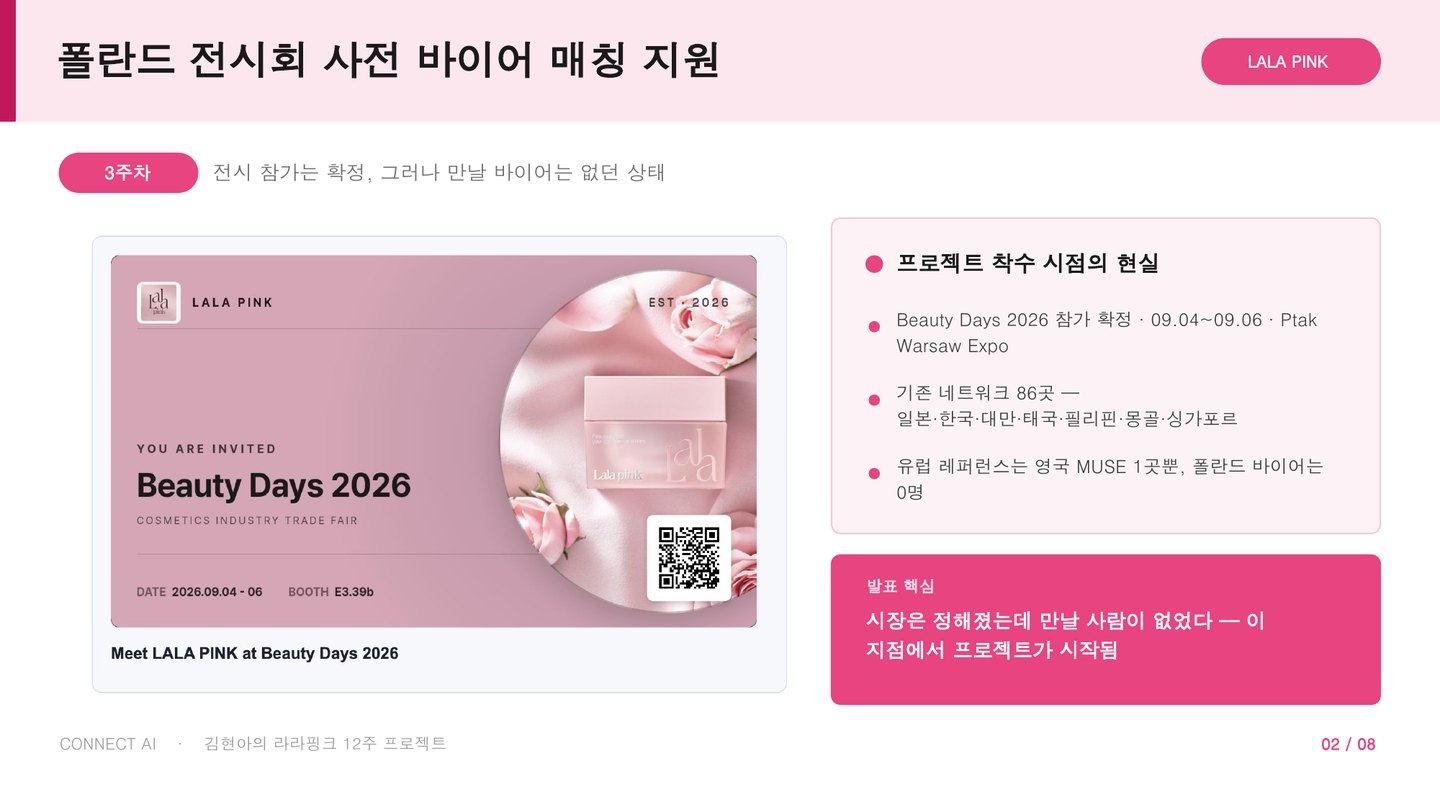
The buyers you meet at a show — what happens to them afterwards?
In GTEP, students work on show preparation, promotional material, interpreting and running the booth — the groundwork of trade practice. That is how I started too.
But for a card exchanged at a booth to become an actual deal, there has to be disciplined selling after the show. Nothing happens automatically between collecting a card and that person showing up to a meeting next month.
My role on this project went past research: deciding which market to enter, and designing and running the strategy for which buyer gets which product and which training programme.
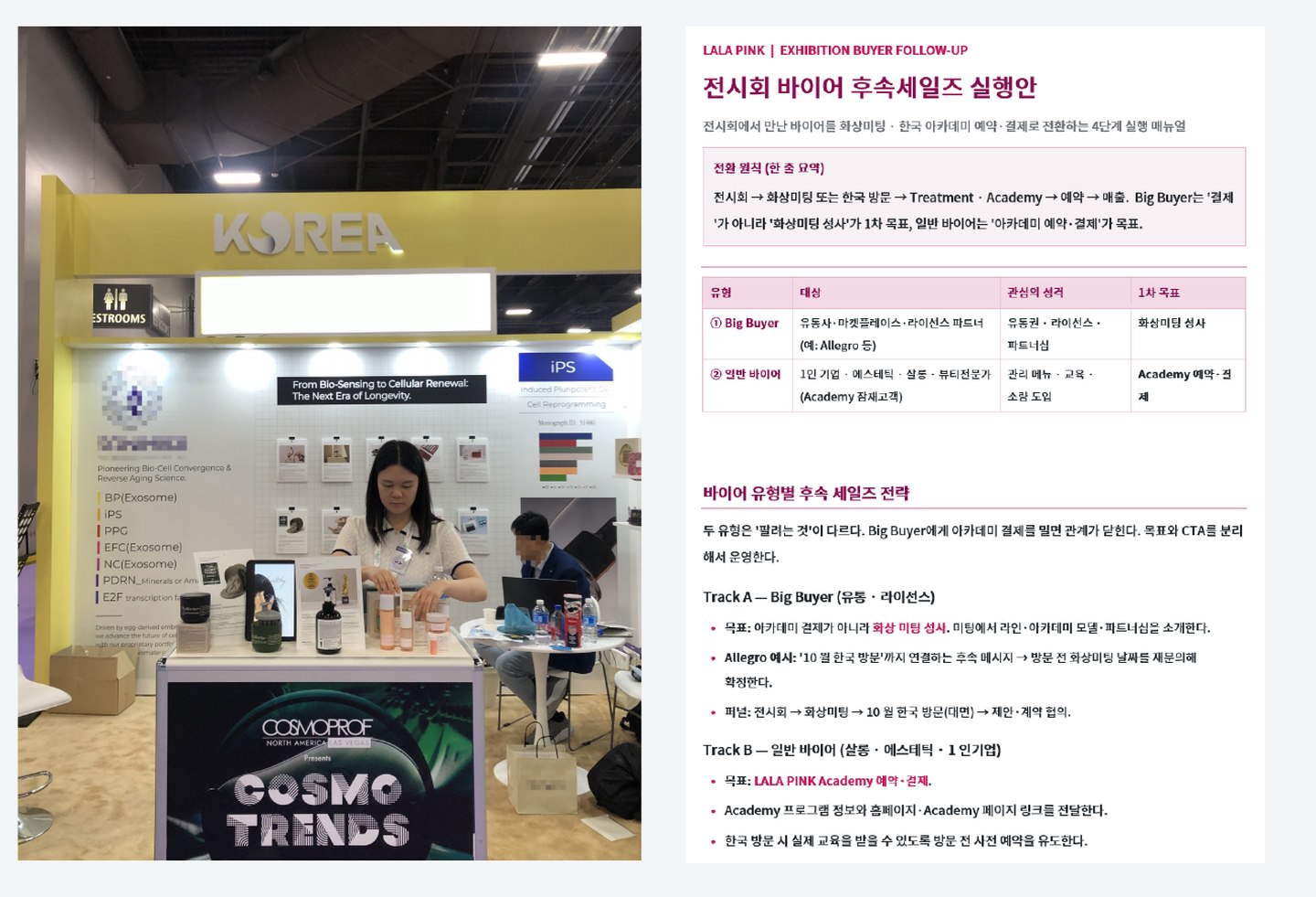
What exactly is the ‘AI trade global sales’ job?
Analysing markets and companies, selecting qualified buyers, writing a message per buyer, making contact, then turning the response into data and revising the next proposal — the whole twelve-week cycle.
Ordinary market research ends when the report is filed. This work is not finished until “who replied, and what sales action follows” is answered.
The twelve-week AI trade global sales project
| Period | Main activities | What accumulates with the company |
|---|---|---|
| Wks 1–2 | Establish LALA PINK’s export readiness for its products and training business, and verify information on candidate companies to invite | An export-readiness baseline and a candidate buyer pool |
| Wks 3–4 | Define the core buyer types — clinics, aesthetic salons, specialist beauty distributors — and analyse their products, channels and existing brands | A definition of the right buyer for LALA PINK, and priorities |
| Wks 5–6 | Analyse which products and training partnerships suit each buyer, then write and get approval for messages matched to the company and the role | An approach strategy per buyer and approved sales messages |
| Wks 7–8 | After company approval, make contact by email and WhatsApp and record opens, replies, questions and intent to visit the show | Buyer behaviour data and interest classification |
| Wks 9–10 | Send follow-ups by level of interest and propose the next step — a show visit, an online meeting or training in Korea | High-engagement buyers and possible follow-up meetings |
| Wks 11–12 | Accumulate contact history, proposals, responses and next contact dates in MORI, then hand over to the company and verify results | A reusable overseas-sales database and a job portfolio |
What was the test for a buyer that actually fits LALA PINK?
Not size, and not name recognition. LALA PINK sells more than cosmetics — it pairs professional melanin care products with a training programme. So the core targets were the places that can take both: clinics, aesthetic salons and specialist beauty distributors.
The question was never “how big is this company” but “can this company actually run and sell our products and protocol”. The search went beyond Poland into Czechia, Estonia, Hungary, Latvia and Romania — six Central and Eastern European markets — and buyers were sorted into three channels (salon, training centre, distributor) and ranked by fit with LALA PINK’s training model.
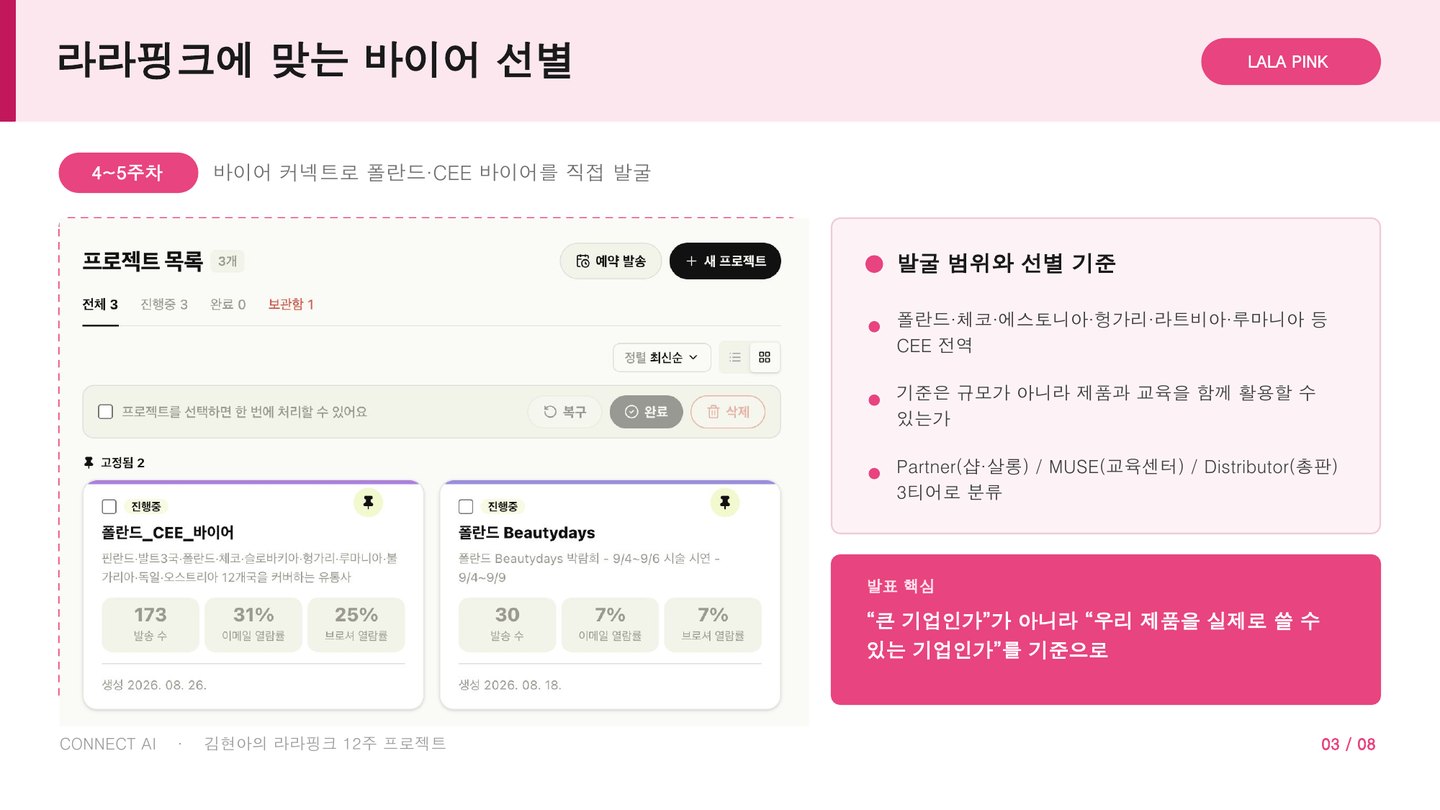
What separates a buyer list from buyer intelligence?
A usual buyer list stops at a company name and a contact. What we built is data for actual selling.
Alongside the basics we recorded why LALA PINK should be proposed to that company, which product and programme fit, the message to approach with, whether they opened the material, and the follow-up. It does not stop at finding a contact — the next sales action is designed for every buyer.

You prepared a floor manual in advance as well?
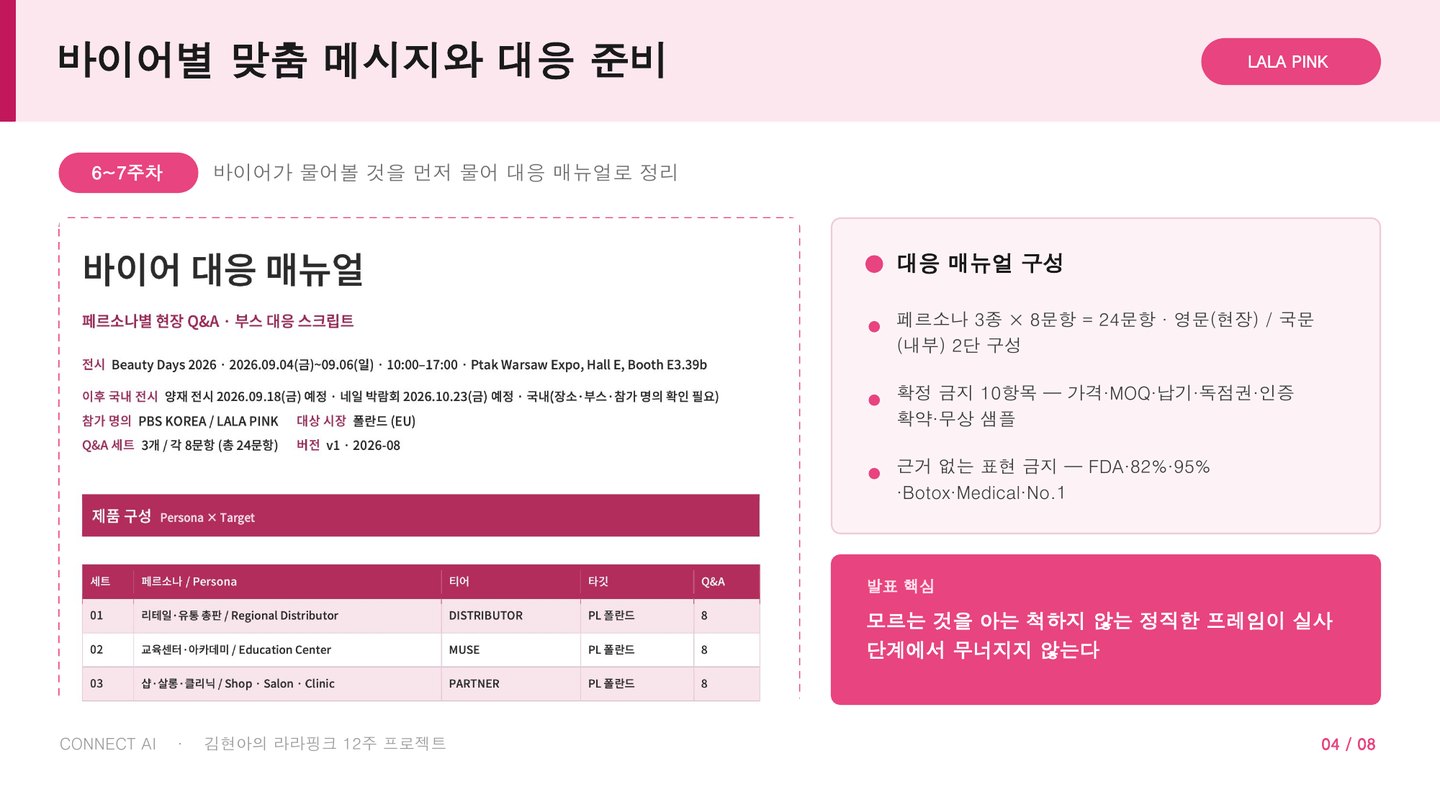
To handle the floor without improvising, we pulled eight core questions for each of three buyer personas — twenty-four in all — and wrote the manual in Korean and English.
What mattered more than the answers was deciding what not to answer. Price, minimum order quantity, lead time, exclusivity, free samples: ten items that must never be settled on the spot. Giving only verified information, rather than pretending to know, is what protects trust when a buyer moves to due diligence.
How did the outreach land, and how is the follow-up running?
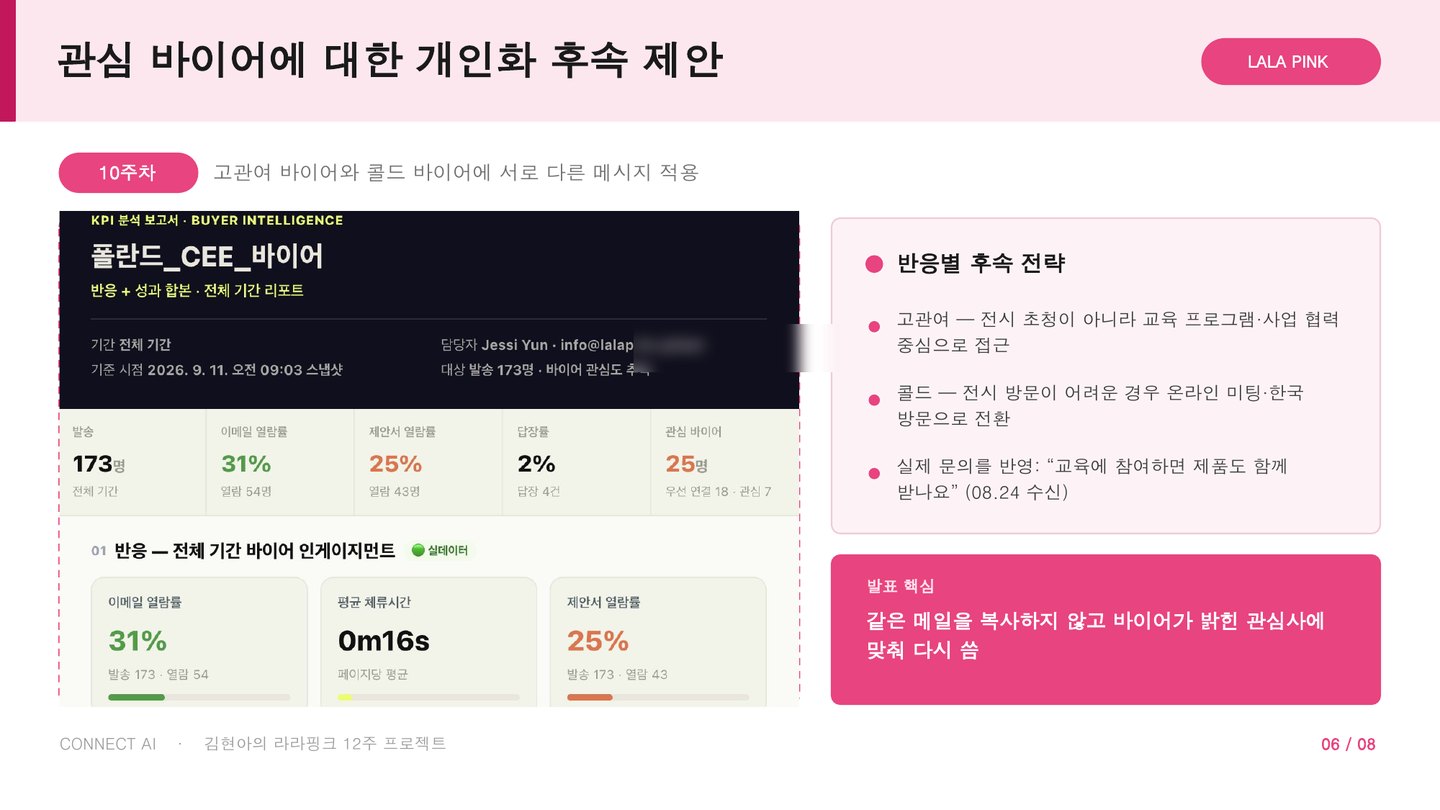
Tailored messages went to 173 buyers: a 31% open rate, four replies, and 25 target buyers secured (18 priority, 7 to watch). Buyers were classified on real engagement — revisits and actual replies — not on open rate alone.
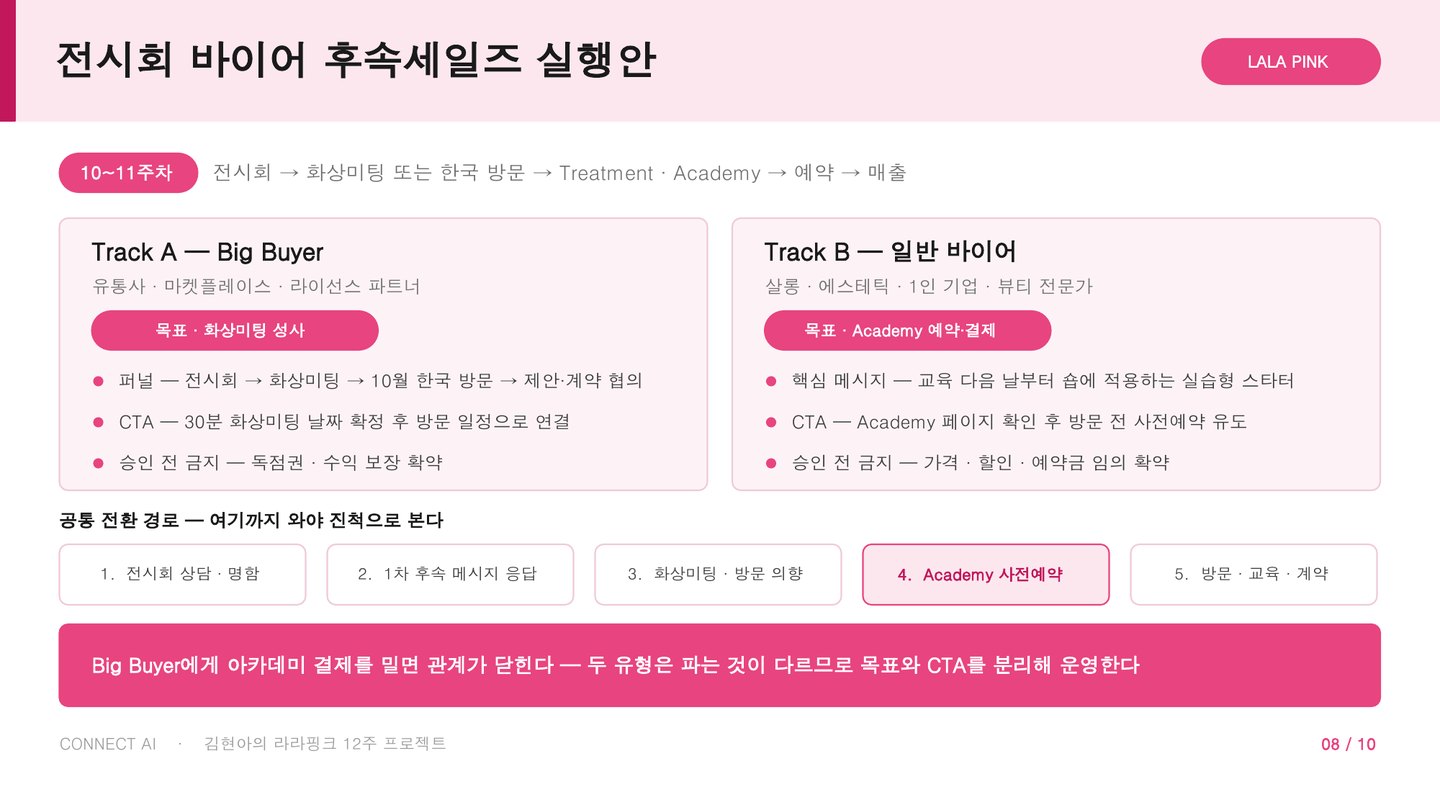
The follow-up diverges with the response. Large distributors are offered a video meeting; salons and solo professionals are offered a training booking. A five-stage pipeline runs from the booth conversation through the first follow-up, a meeting or visit intent, a pre-booking, and finally a contract — and anything stalled mid-pipeline is not counted as a result.

What stays with the company once the project ends?
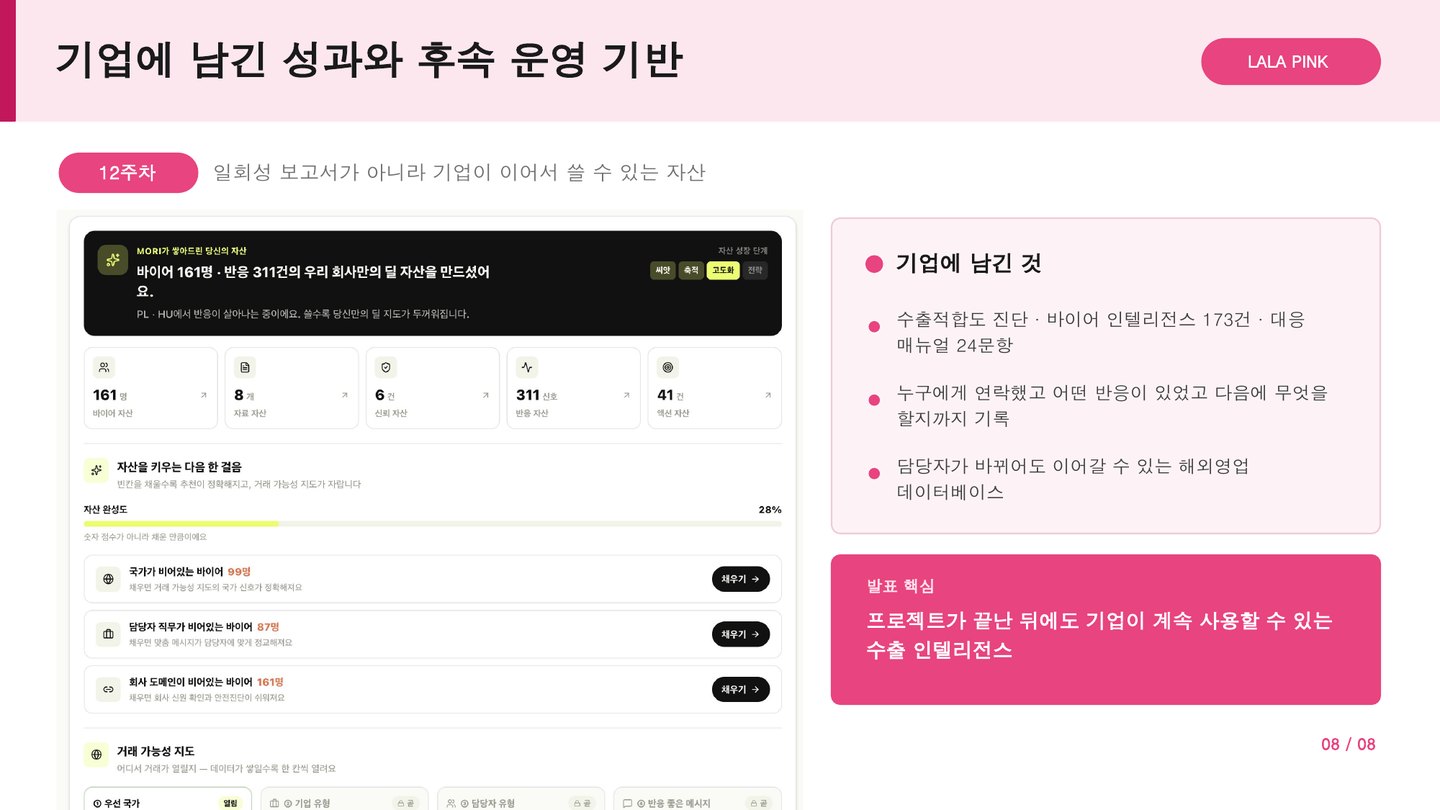
It does not end as a one-off event or a report. So the company can keep selling abroad on its own, a database of 161 target buyers, 311 response records and the twenty-four-question manual are handed over in order.
Even if the person in charge changes, the contact history and response data can be read immediately — an overseas-sales database the company owns as an asset.
What does it mean to call this your first real job experience?
Using AI for market research or coursework is one thing. Taking a real company’s product and driving the whole cycle — target analysis, buyer contact, data-led revision of the strategy — is another thing entirely.
I ran every stage myself: market analysis, buyer discovery, tailored messaging, live contact, response analysis and revising the follow-up. That is why this is not a training certificate but a first career in a job, measured by what it produced in a real market.

Buyer intelligence is not a contact list. It is a working asset, built so the next sales action can be decided on the spot.Kim Hyun-a · AI trade global sales specialist
With government agencies, associations and universities, CONNECT AI runs AI trade talent development and first-career projects for young people in the regions — case-based lectures, a live MORI demo, and a tailored twelve-week pilot design.
Request a demo or lectureParticipants complete AI trade job training, then join a local exporter to run market analysis, buyer intelligence, global sales and follow-up. They finish with a job portfolio covering the period, the role, the outputs, the metrics and the company’s confirmation.
What is the AI trade global sales role?
It analyses overseas markets and target companies, selects qualified buyers, makes direct contact with a message written for each of them, and designs the follow-up from the response data. It does not stop at a research report — it carries through to who replied and what sales action comes next.
Where did this project start?
The booking for Beauty Days in Poland was confirmed, but Polish buyers numbered zero. The 86 existing contacts were concentrated in Asia with a single European reference. So the work began by finding buyers that fit the brand and drawing them to the floor before the show opened.
What are the results so far?
A first round reached 173 target buyers: a 31% email open rate, four replies and 25 target buyers (18 priority, 7 to watch). The company holds a database of 161 buyers, 311 response records and the twenty-four-question manual. The project is ongoing, and the goal for this round is one pilot agreement rather than a quick contract.
Why are the buyers not named?
The companies and individuals actually contacted are third-party personal data and part of the client’s commercial confidentiality. This article therefore describes only the channel structure — distributor, retail chain, marketplace — and the names and email addresses on screen are masked.
Can an agency or a university run the same project?
Yes. CONNECT AI supports government agencies, local authorities, associations and universities with case lectures on the INU GTEP and LALA PINK projects, a live MORI demo, and a tailored twelve-week pilot programme design.
Creating the people you will meet — data-led AI trade global sales is becoming the new standard of trade practice.