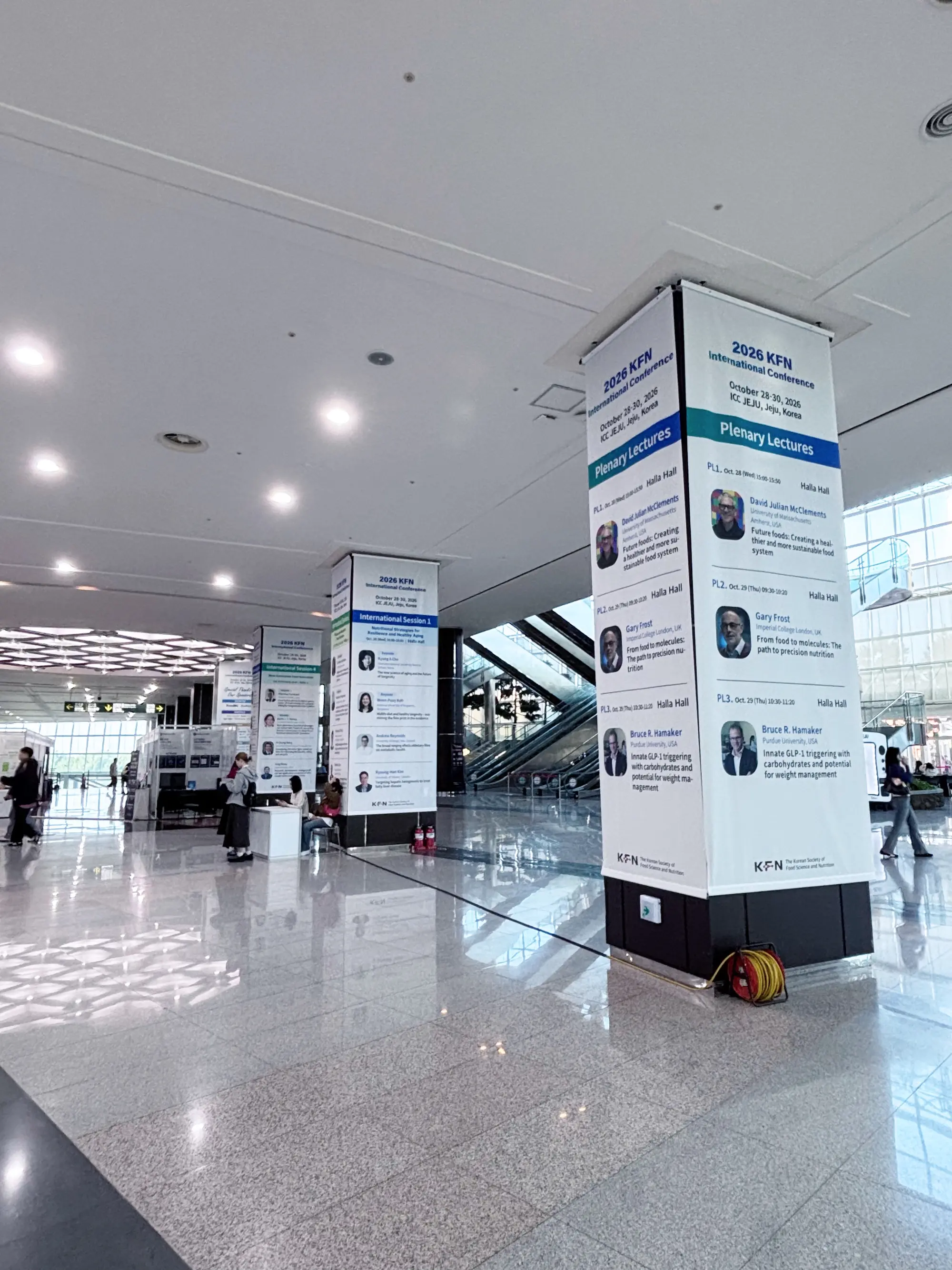
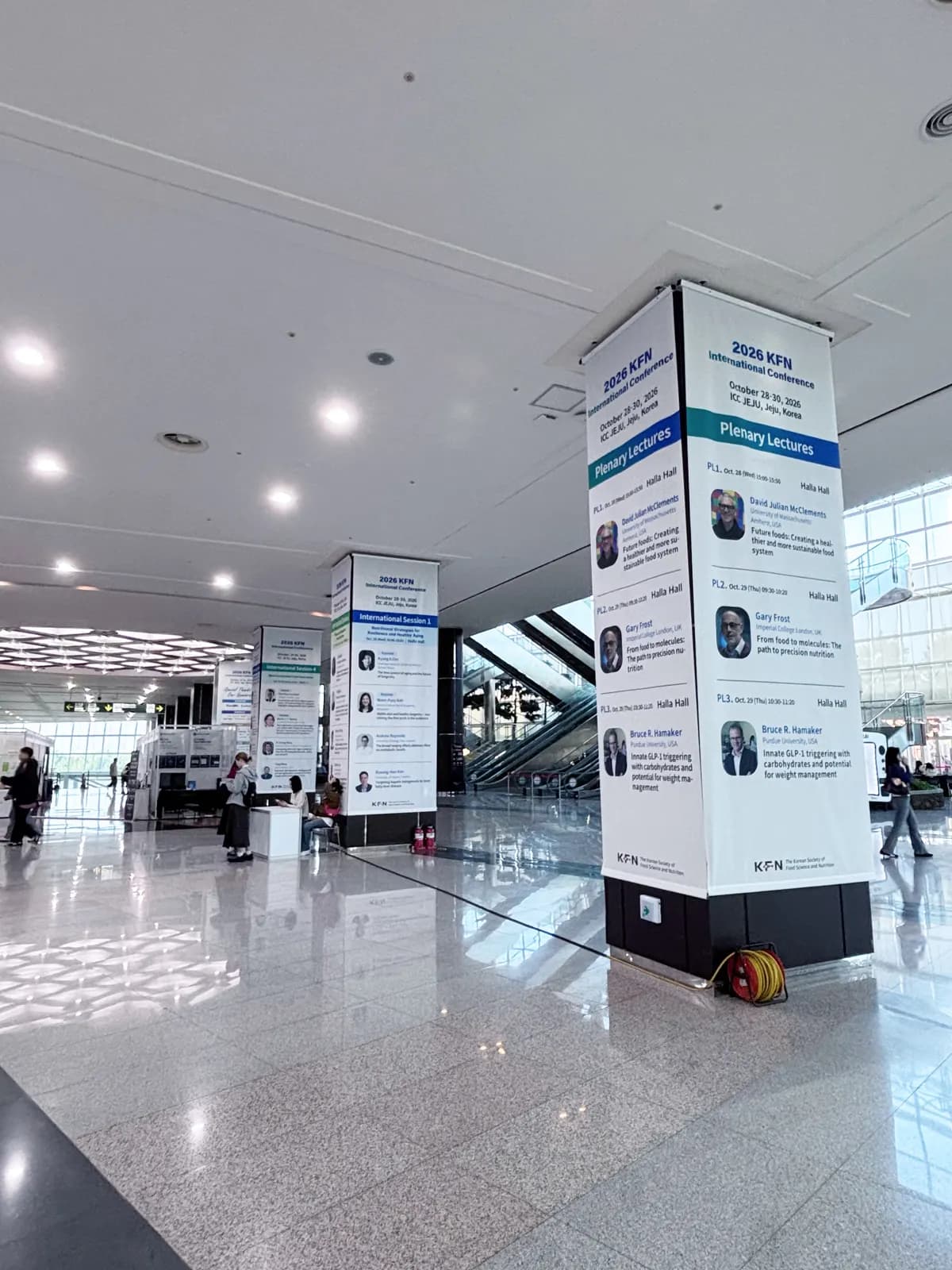
Song-Yi Yang, Co-Founder and CGO of CONNECT AI, spoke as an invited speaker at the 2026 International Conference of the Korean Society of Food Science and Nutrition (KFN) on October 30 at the International Convention Center Jeju (ICC JEJU), presenting “Transforming health functional food value chains and enhancing trade competitiveness through AI.”
Session 28, “Beyond AI: A New Paradigm for the Health Functional Food Industry,” sponsored by the Korea Health Functional Food Association, concluded successfully. Yang noted that AI work in the industry has largely stayed with ingredient discovery and product development, then used the case of an innovative flavor-generation AI company to show how market intelligence, regulatory analysis, buyer discovery, sales and post-contact management — where export results are actually decided — can be joined into one AI-supported flow.
A live Q&A with the audience followed the talk.
KFN 2026 IN NUMBERS
The 2026 KFN International Conference in numbers
Under the theme “Reinventing Food and Nutrition: Advancing from Core Science to Expanded Horizons toward 2050,” a society founded in 1971 hosted three days of international science.
- 1971Society foundedIncorporated society under Korea’s Ministry of Food and Drug Safety
- ~1,600Regular membersPer the society’s 2026 invitation letter
- 3 daysConferenceOct 28 – 30 · ICC JEJU
- 3Plenary lecturesUMass Amherst · Imperial College London · Purdue
- 37International and general sessions4 international · 33 general sessions
- 10Countries and regions of speakers and chairsKorea, USA, Japan, Singapore, Taiwan, China, Canada, UK, New Zealand, Australia
- 5Sessions with AI in the titlePrecision nutrition, food safety, food data, functional ingredients, health functional foods
- 3Societies in the joint symposiumKFN · Japan Society of Nutrition and Food Science · Nutrition Society of Taiwan
Sources: official 2026 KFN International Conference program; KFN invitation letter (Sept 9, 2026). Countries and regions reflect speaker and chair affiliations listed in the program, not attendance.
2026 KFN International Conference website (Opens in a new window)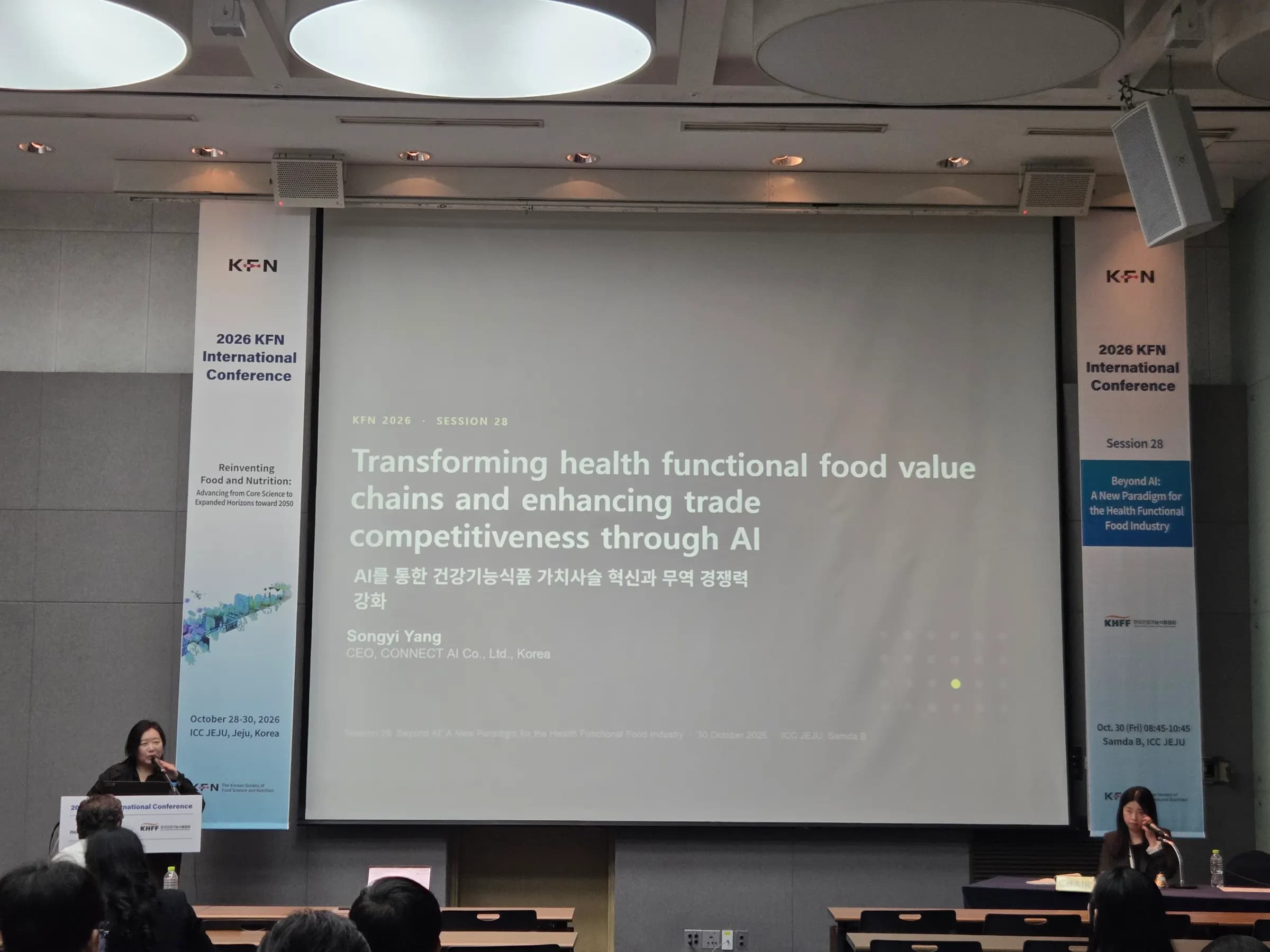
TALK SUMMARY
Talk summary: AI’s next stage is beyond the lab
Where the previous talk covered matching demand with technology, Yang focused on what comes after a product exists: finding overseas buyers, reading their interest and turning it into real business — and what AI can do there.
The right side of the value chain, where export results are decided
Most AI discussion in health functional foods has centered on ingredient discovery and product development. But export results are decided later: which market, which regulatory route, which buyer and when. Those calls still rely on personal memory, spreadsheets and business-card binders.
- 01Research & ingredients
- 02Product development
- 03Market intelligence
- 04Regulatory analysis
- 05Buyer discovery
- 06Sales engagement
- 07Post-contact management
THE PROBLEM
Five friction points in global business development
Diverging requirements
Every market classifies, regulates and labels products differently.
The same product is a health functional food in Korea, a dietary supplement in the US and a Food with Function Claims product in Japan.
Fragmented buyer data
Business cards, spreadsheets, inboxes and trade show lists live apart.
No one can see in one place which buyer has been contacted and how far each talk went.
Thin BD resources
One or two people cover several markets and languages.
Little time is left for each individual buyer.
Lost momentum
A few weeks after a trade show or business meeting, the momentum fades.
Miss the moment to follow up, and meetings do not turn into deals.
Knowledge walks out
When people leave, buyer history and context leave with them.
The next person rebuilds each buyer relationship from scratch.
They look like five problems, but they are one: information that is not connected.
An AI global sales team for an innovative company — people decide
Innovative companies often have strong R&D but little or no overseas sales team. Instead of hiring five people to analyze markets, find buyers, handle regulation and trust, read responses and lead proposals, CONNECT AI designed five roles for AI to take on.
Decide and approve — the company’s CEO and R&D lead
- 01
Market analyst AI
What to sell — and where to prove it firstThe offer was redefined: sell the success of one new product for the customer, not the machine. And one field at a time.
Four steps of the offer
- Mood brief — brand concept, customer, launch date
- Flavor prototype — manufacturable candidates and physical samples
- Local validation — preference, formulation, stability, cost
- Repeat supply — flavor ODM and per-product usage rights
- 02
Buyer researcher AI
By role, not by volumeThree partner types were defined by their role in the deal, each with a set test for when a first meeting counts as done. Candidates were verified through official websites and company databases; names were not disclosed.
Three partner types
- Who pays — a manufacturer with its own brands and production
- Who validates — a lab handling local prototyping, application and evaluation
- Who operates — an operator with rental and on-site support teams
- 03
Trust & compliance AI
Set boundaries before promisesThe most common mistake with overseas buyers is promising too much on the spot. The rule: no commitments on price, lead time, IP or exclusivity before authorized approval. For health functional foods, promises beyond functional claims and certification scope are the fastest way to lose trust.
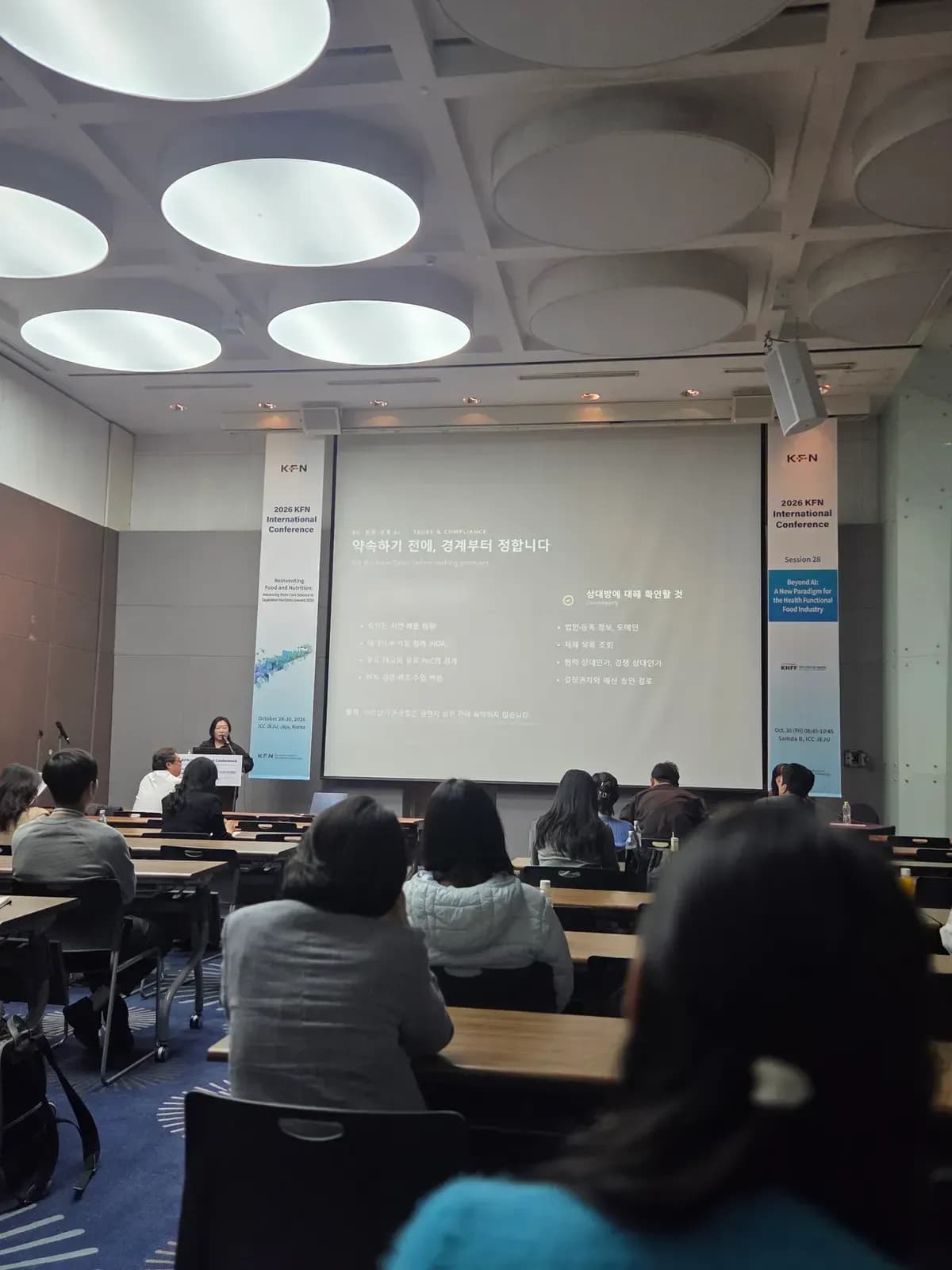
Trust & compliance AI — no commitments on price, lead time, IP or exclusivity before authorized approval - 04
Signal analyst AI
Not a list of names — booked, qualified meetingsInstead of contacting many buyers with the same intensity, qualification criteria come first and only companies that meet them are invited to a video meeting. Signals are shown as grades, not numeric scores; they guide priority and are not proof of purchase intent.
Qualification — four must-haves
- A product plan within six months
- An owner of development and budget
- Pain with the current alternative
- A local validation and manufacturing path
Video · DBIFrom the official CONNECT AI YouTube channel · Digital Behavior Intelligence, reading buyer interest from behavioral signals · On-screen text: Korean and EnglishWatch on YouTube (Opens in a new window) - 05
Sales coach AI
AI recommends the next action; people decideFor example: “This buyer reopened your spec sheet twice this week. Send stability data and propose a sample shipment.” It recommends the next action from the signals, but a person always presses the final send button.
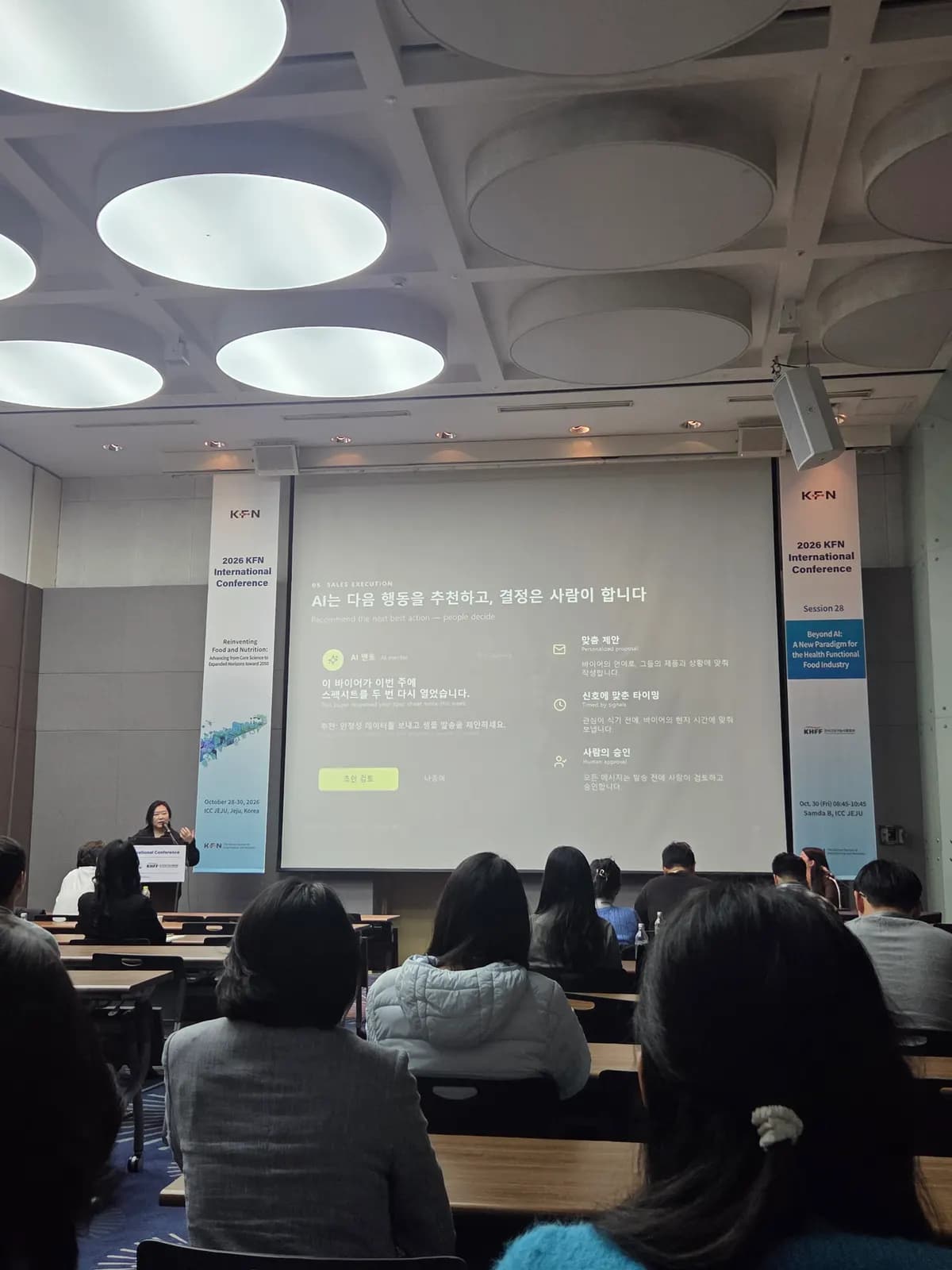
Sales execution — AI recommends the next action; people decide
CONNECT AI consultants review the AI output in MORI and run the operation. AI does the work; people decide.
From fragmented tasks to one continuous cycle
The five steps are connected as one cycle rather than run separately. What the cycle produces is not information used once and thrown away, but a company asset that grows with every turn.
- 01Market intelligence
- 02Buyer discovery
- 03Regulatory readiness
- 04Behavioral signals
- 05Sales execution
Each turn of the cycle feeds the next market.
Every interaction becomes a reusable digital trade asset
| Event by event | Compounding cycle | |
|---|---|---|
| Data | Files scattered by event | One buyer record that keeps growing |
| Insight | Personal memory | Signals and interest grades per buyer |
| Continuity | Lost when people change | Kept as a company asset |
| Next market | Start from scratch | Reuse customer profiles, materials and evidence |
WHAT COMES NEXT
2027: the era of trading with AI and data
Soon a buyer’s first question will come from an AI agent, not a person. When the buyer’s agent searches for suppliers, compares, verifies and requests quotes, our company’s agent answers, sends evidence and negotiates terms.
People still make the final decision. But AI builds the shortlist they see — and companies that miss it may never get reviewed.
- Discover
- Verify
- Quote
- Negotiate
Companies AI can read are the ones that get chosen
Digital trade assets — data our AI can use
- Structured buyer and transaction records
- Evidence such as certifications, tests and clinical data
- A history of responses, decisions and holds
AI visibility — signals the buyer’s AI can find
- Can AI find the company and its products?
- Can it read and cite certifications and supply records?
- Is public information consistent and clearly sourced?
Digital trade assets × AI visibility = trade competitiveness in the AI era
AI visibility strengthens the evidence AI can read; it does not guarantee a recommendation.
Yang stressed that the scientific evidence researchers produce — certifications, tests and clinical data — is the strongest material for both.
ON SITE
Three days in Jeju — and forty minutes in Samda B
Plenary lectures and international and general sessions ran across three days. On the final morning, Samda B hosted Session 28, linking AI with the health functional food industry.

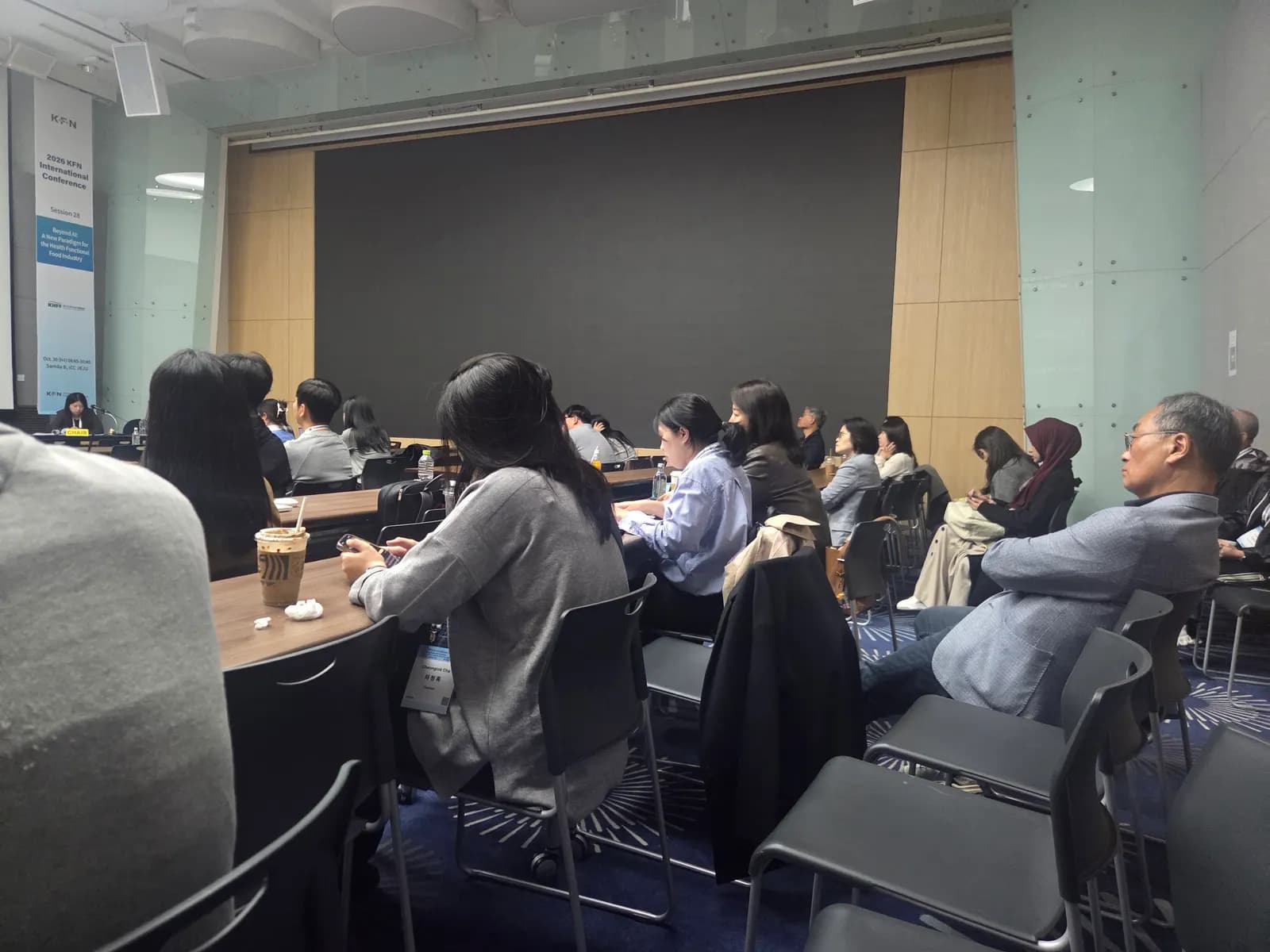
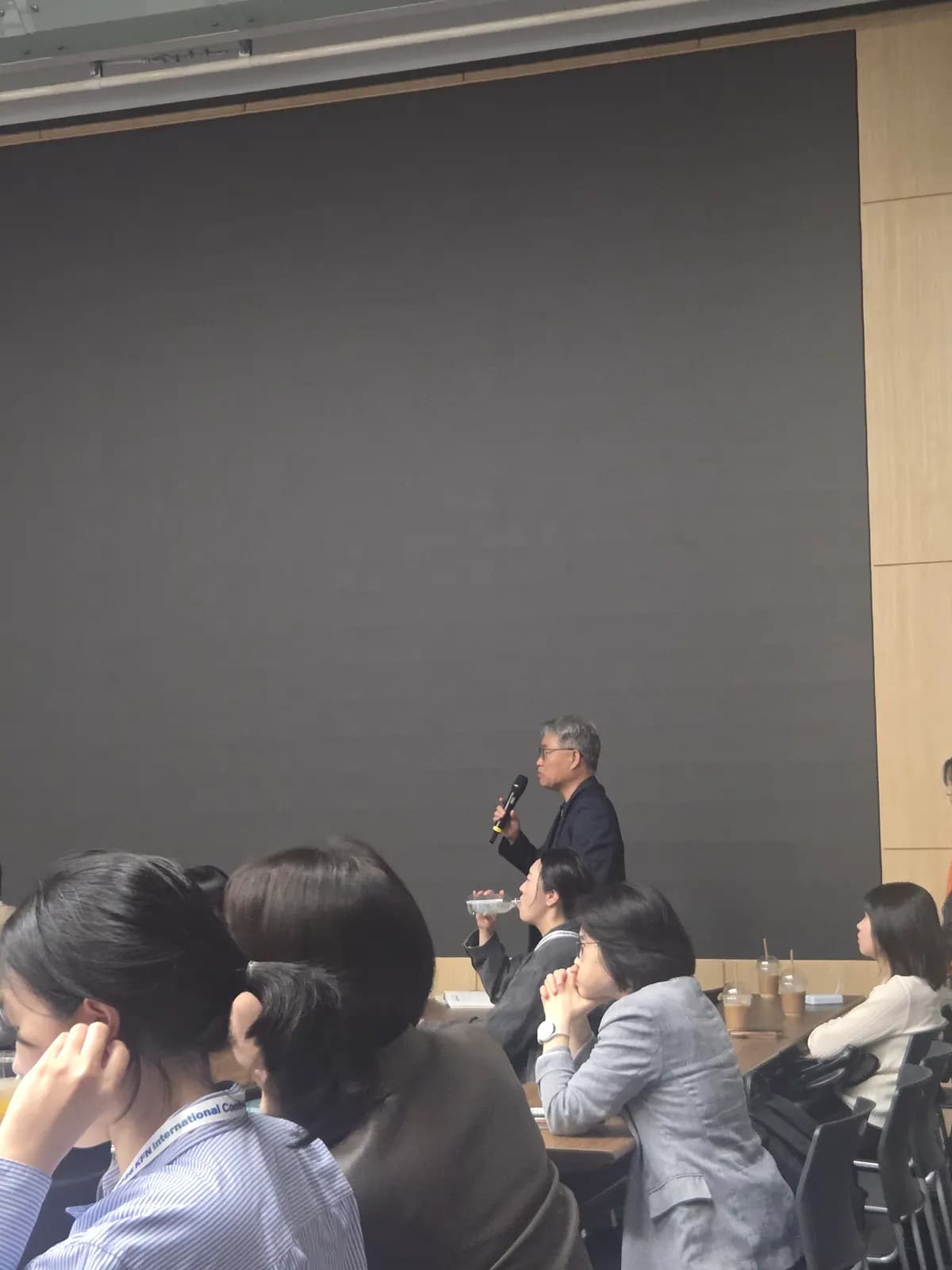
Slides in the on-site photos are the original talk slides, in Korean and English.
FOR YOUR TEAM
Where should your company start building digital trade assets?
Start with one product and one market. We will review with you how to turn buyer responses into a record your company keeps.